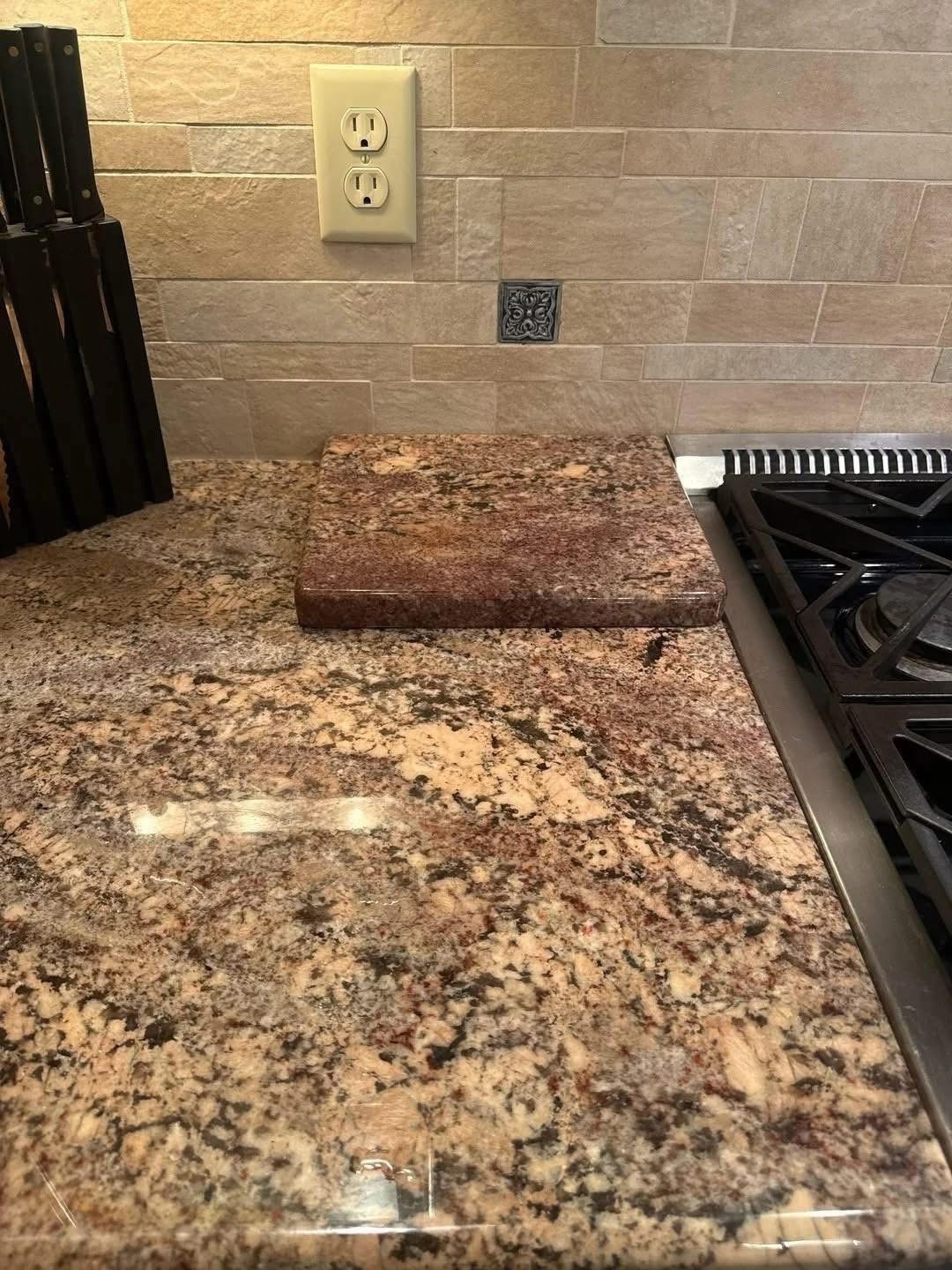

you’ve recently moved into a house built or remodeled between the late 1980s and the early 2000s, you might have stumbled upon a highly specific, slightly baffling design feature. Nestled right next to the stovetop, permanently affixed to the countertop, sits a raised, thick square slab of polished granite or marble.
It doesn’t match the surrounding tile backsplash perfectly, it takes up valuable prep space, and it looks exactly like a cutting board that someone forgot to put away—except it’s completely unmovable.
To younger generations, this stone square is an architectural riddle. But Baby Boomers and Gen Xers know exactly what it is. It isn’t a mistake, and it isn’t an oddly placed pastry board. It’s a built-in heavy-duty heat pad, and its presence tells a fascinating story about the evolution of modern kitchen engineering.
The Birth of the “Built-In Trivet”
To understand why these stone slabs became a premium kitchen upgrade, you have to look at the massive shift in countertop technology that happened in the late 20th century.
Before granite became the king of suburban kitchens, the vast majority of homes featured Formica or laminate countertops. While laminate was affordable and came in endless colors, it had one fatal flaw: it absolutely loathed heat. Placing a bubbling pot of chili or a screaming-hot cast iron skillet directly onto a laminate surface would instantly scorch it, leaving a permanent, melted brown ring.
As custom kitchen design took off in the Boomer era, clever builders started incorporating a luxurious solution right next to the range. They would cut out a section of the laminate and drop in a thick, raised piece of leftover stone—usually granite, quartz, or marble.
This served as a permanent, indestructible landing pad for hot pots and pans straight off the fire, protecting the surrounding laminate from thermal disaster.
Why Put a Granite Slab on Top of a Granite Counter?
Why Put a Granite Slab on Top of a Granite Counter?
Here is where the mystery deepens for modern homeowners: Why do some kitchens feature a raised granite slab sitting directly on top of a granite countertop? It feels completely redundant. If granite is already heat-resistant, why do you need a second, raised piece of granite to act as a heat pad?
There are three very practical reasons Boomers and their contractors did this:
- The Fear of “Thermal Shock”
While it’s true that granite can handle high temperatures, it is not entirely immune to physics. Granite is a natural, porous stone filled with microscopic fissures and internal crystalline stress points. If you take a heavy Dutch oven heated to 230°C (450°F) and slam it down onto a freezing-cold, thin countertop, the sudden, extreme temperature differential can cause thermal shock. This can lead to the stone cracking right down the middle or popping a seam.
By utilizing a separate, ultra-thick raised block as the designated heat pad, you ensure that if thermal shock does ever crack the stone, it only ruins an easily replaceable accessory block—not your multi-thousand-dollar seamless countertop.
- Protecting the Chemically Sealed Shine
Natural stone countertops are coated with a chemical impregnating sealer to prevent oil, wine, and water from staining the porous rock.
The Hidden Risk: Intense, localized heat from the bottom of a hot pan won’t melt the stone, but it will bake, degrade, and strip away the chemical sealer over time. Once the sealer is destroyed, the stone underneath becomes vulnerable to deep, permanent stains. The raised slab keeps that intense heat elevated and isolated.
- Ergonomics and “Scrape Protection”
Let’s face it: sliding a heavy, abrasive cast iron skillet across a highly polished countertop is a recipe for micro-scratches. A raised slab creates a clear, intentional visual boundary. It tells the cook exactly where it is safe to slide, drop, and rest heavy cookware without worrying about scratching the main surface. Furthermore, the slight elevation makes it easier to slide fingers or a spatula under pot handles when lifting them back up.
The Ultimate Kitchen Relic
As kitchen aesthetics shifted toward minimalist, seamless, ultra-modern expanses of quartz and engineered stone, the built-in raised heat pad fell out of fashion.
If your kitchen features one of these proud, immovable stone blocks next to your burners, don’t view it as an awkward design quirk. It’s a badge of honor from an era of home design that prioritized heavy-duty utility, smart thermal engineering, and the comforting chaos of cooking big, multi-pot family dinners. Treat it well—it’s arguably the toughest employee in your entire house.
Would you like to know how to safely clean and reseal a natural stone heat pad to keep it looking brand new?