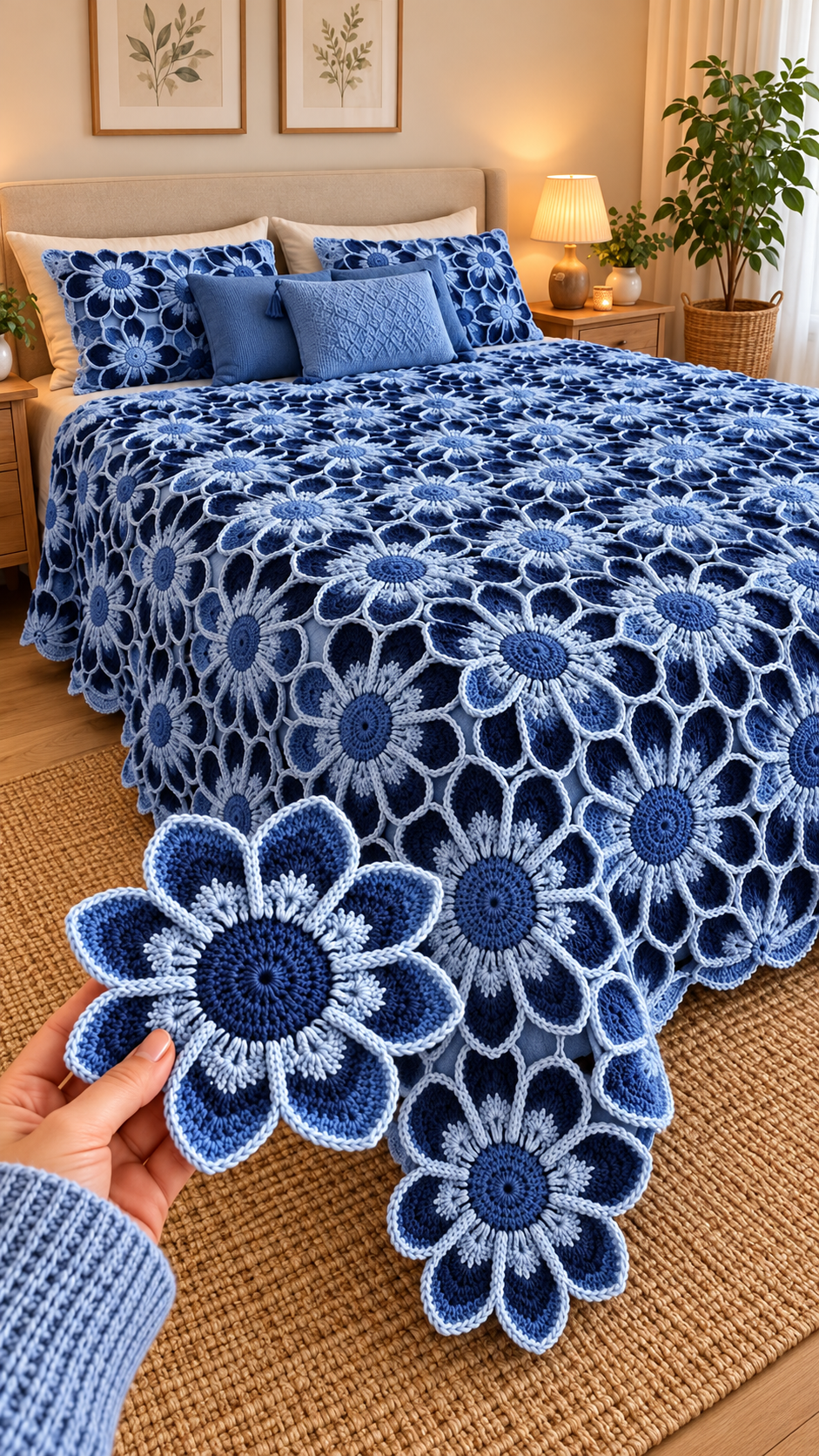

An original pattern inspired by your photo. The exact stitch pattern cannot be recovered from an image; this version recreates the large blue flowers, pale outlines, and openwork joins. Written in US crochet terms; untested.
Materials
- DK or light worsted yarn in navy, medium blue, and pale blue.
- 4–4.5 mm crochet hook, adjusted to your yarn.
- Yarn needle, scissors, and stitch markers.
- Cushion covers in a coordinating blue for backing.
Make and block one complete flower before buying yarn for the full bedspread. Weigh it, multiply by the number of flowers needed, and add approximately 15% for joining and finishing.
Abbreviations
- ch: chain
- sl st: slip stitch
- sc: single crochet
- hdc: half double crochet
- dc: double crochet
- sc2tog: single crochet two stitches together
- inc: work 2 sc in the same stitch
Turning chains do not count as stitches.
1. Flower center
Using medium blue, make a magic ring.
- Round 1: Work 12 dc into the ring. Join with a sl st. (12)
- Round 2: Ch 2, work 2 dc in each stitch. Join. (24)
- Round 3: Ch 2, repeat [1 dc, 2 dc in the next stitch] around. Join. (36)
- Round 4: Ch 1, repeat [2 sc, 2 sc in the next stitch] around. Join. (48)
Fasten off. Mark eight groups of six stitches around the center. Each group supports one petal.
2. Make eight petals
Work each petal back and forth over one marked group. Start with navy.
- Row 1: Join yarn in the first stitch of the group. Ch 1, sc in the same stitch and the next 5 stitches. Turn. (6)
- Row 2: Ch 1, inc, 4 sc, inc. Turn. (8)
- Row 3: Ch 1, inc, 6 sc, inc. Turn. (10)
- Row 4: Ch 1, sc across. Turn. (10)
- Row 5: Ch 1, sc across. Turn. (10)
- Row 6: Change to medium blue. Ch 1, sc across. Turn. (10)
- Row 7: Ch 1, sc2tog, 6 sc, sc2tog. Turn. (8)
- Row 8: Ch 1, sc2tog, 4 sc, sc2tog. Turn. (6)
- Row 9: Ch 1, sc2tog, 2 sc, sc2tog. Turn. (4)
- Row 10: Ch 1, sc2tog twice. (2)
Fasten off. Repeat over the remaining seven groups.
3. Pale blue petal outlines
With the right side facing, join pale blue at the base of one petal.
- Sc evenly up its side, starting with approximately one sc per row end.
- At the tip, work 2 sc in each of the two final-row stitches.
- Sc evenly down the opposite side.
- Sl st at the base between this petal and the next.
Continue around all eight petals. Join and fasten off.
The edging should lie flat. Add a stitch where it pulls inward or skip a row end where it ripples.
4. Add the pale blue rays
The photo has decorative pale stitches radiating outward from each center. Recreate these with embroidery.
Using pale blue and a yarn needle:
- Make five straight stitches at the base of each petal.
- Arrange them like a small fan.
- Make the central stitch longest, reaching about four petal rows outward.
- Make the surrounding stitches progressively shorter.
- Keep the yarn relaxed so the petals remain flat.
Repeat on all eight petals and secure the ends on the back.
5. Block the flowers
Dampen each flower and pin it flat, spacing its eight petals evenly. Let dry completely.
Measure the finished diameter. The size depends on your yarn and tension.
6. Join the bedspread
Arrange flowers in a rectangular grid, rotating each so two petals face each neighboring flower.
Using pale blue:
- Place neighboring flowers right sides up.
- Match their two facing petal tips.
- Whipstitch the central 2–3 edging stitches of each matched tip together.
- Repeat across the row, then join subsequent rows.
Keep the seams loose enough to preserve the flower shapes.
Optional connecting rings: Where four flowers leave a large central opening, make a separate ring: ch 6, join into a circle, work 12 sc into the ring, then fasten off. Sew four evenly spaced points of the ring to the surrounding flower edges. Adjust the ring size after checking the first gap.
For sizing, join four flowers into a sample square and measure the actual spacing between their centers. Use this spacing to calculate your rows and columns.
For example, if your blocked flowers measure 25 cm and meet without overlap, an 8 × 9 arrangement uses 72 flowers and measures approximately 200 × 225 cm.
7. Finish the edges
Keep the outer flower petals exposed for the scalloped silhouette shown in the photo. Their pale blue edging serves as the blanket border.
Weave in every end securely and block the assembled bedspread gently.
8. Matching cushions
Make enough flowers to cover the front of your cushion and join them using the same method.
For a 45 × 45 cm cushion, four flowers measuring approximately 22–23 cm each may work; check the joined panel against the cover.
Sew the panel onto a plain navy cushion cover, securing the flower centers and selected petal tips. Keep the cover opening accessible.
For the closest visual effect: use navy for most of each petal, medium blue for the centers and tips, and pale blue for all outlines, embroidered rays, and joins.
