
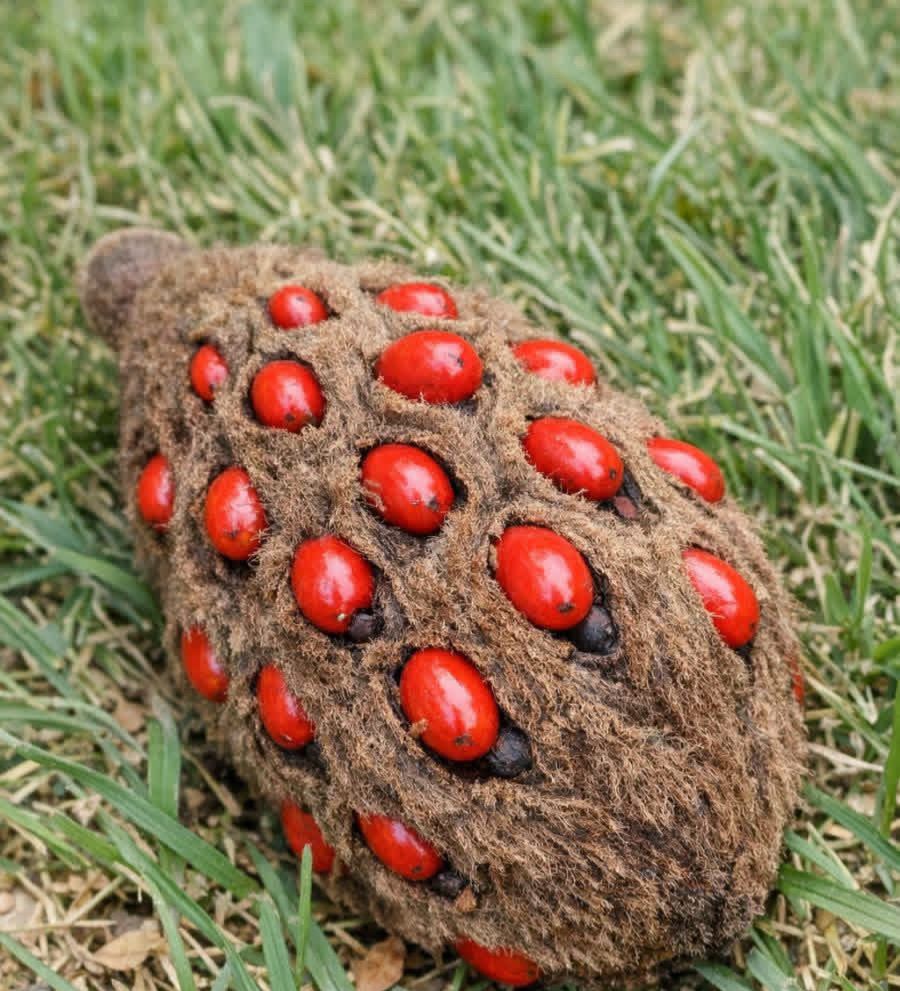
You’re walking across the lawn when something catches your eye—a peculiar object nestled in the grass. At first glance, it seems otherworldly: a velvety, cone-shaped structure dusted in soft fuzz, split open to reveal clusters of brilliant crimson seeds that gleam like tiny jewels against the earth. It looks almost alien—perhaps a prop from a sci-fi film or a curious hand grenade dropped from the sky.
But this is no mystery from beyond. It is one of nature’s oldest invitations—a magnolia seed pod, resting where it fell beneath its parent tree. And within its fuzzy embrace lies a story millions of years in the making.
What You’ve Found: The Magnolia Seed Pod
This distinctive structure is the fruit of the magnolia tree—a living fossil whose lineage stretches back over 95 million years, predating bees and even butterflies. The pod itself measures 2–4 inches long, covered in a soft, felt-like texture that ranges from pale taupe to silvery gray. As it matures in late summer through fall, the cone splits open along its seams, revealing seeds cradled in vivid red arils—fleshy coverings that pulse with color against the muted pod.
This striking contrast isn’t accidental. It’s an evolutionary masterpiece: the red arils act as nature’s billboards, calling to birds and small mammals with a promise of nourishment. In eating the seeds, these creatures become unwitting gardeners—carrying magnolia DNA to new corners of the forest through their droppings.
The Trees That Bear Them
Magnolia seed pods appear beneath several common species:
→ Southern Magnolia (Magnolia grandiflora) – Evergreen giant of the Southeast, with glossy leaves and lemon-scented white blooms
→ Sweetbay Magnolia (Magnolia virginiana) – Slender wetland dweller with silvery-backed leaves
→ Cucumber Tree (Magnolia acuminata) – Named for its unripe pods that resemble small cucumbers
These trees flower in spring; the pods develop slowly through summer, ripening as days shorten—a quiet testament to a season’s journey.
Safety & Identification
Are they poisonous?
The seeds aren’t highly toxic but taste intensely bitter and may cause stomach upset if eaten. Wildlife relishes them; humans and pets should admire rather than consume. Keep curious children and animals from chewing the pods as a precaution.
How to distinguish from look-alikes:
True magnolia pods are unmistakable:
✓ Fuzzy, cone-shaped exterior
✓ Bright red seeds emerging in orderly rows
✓ Found beneath trees with large, leathery leaves and (in season) fragrant, saucer-sized flowers
✓ Not to be confused with toxic plants—magnolia pods pose no danger beyond mild gastrointestinal irritation if ingested
A Feast for Wildlife
These pods sustain a quiet ecosystem:
→ Cardinals and grosbeaks pluck seeds with precision
→ Squirrels gnaw at the fibrous cone to reach hidden treasures
→ Even beetles—magnolias’ original pollinators from the age of dinosaurs—still visit their flowers today
This relationship isn’t incidental. Magnolias evolved before bees existed, relying on beetles drawn to their sturdy, pollen-rich blossoms. The seed pod’s design continues that ancient partnership—ensuring life spreads, season after season.
What to Do With Your Discovery
You have gentle choices:
→ Leave it be – Let it decompose naturally, returning nutrients to the soil
→ Display it – Its sculptural beauty makes a striking autumn centerpiece (seal with hairspray to preserve)
→ Grow a legacy – Collect seeds, remove red arils, and stratify in damp sand in the refrigerator for 3–4 months before planting. Patience rewards: a seedling may emerge in spring, carrying 95 million years of resilience in its tiny stem
That fuzzy cone beneath your tree is more than a curiosity. It is a living archive—a direct link to forests that thrived when dinosaurs walked the earth. In its quiet splitting open, it performs a ritual unchanged for epochs: offering beauty as bait, trusting creatures to carry its future forward.
So the next time you spot one, pause. Run your fingers gently over its velvet surface. Admire the crimson seeds like drops of captured sunset. And remember: you’re not just looking at a seed pod.
You’re holding a piece of deep time—
a whisper from an ancient world,
still speaking in color and fuzz and quiet generosity