
Materials
Cream cotton crochet thread
Olive green cotton crochet thread
Dark sage green cotton crochet thread
Crochet hook suitable for the yarn, approximately 2.5–3 mm
Tapestry needle
Scissors
Small cream wooden or crochet beads for flower centers
Blocking pins and a blocking mat
Finished Design
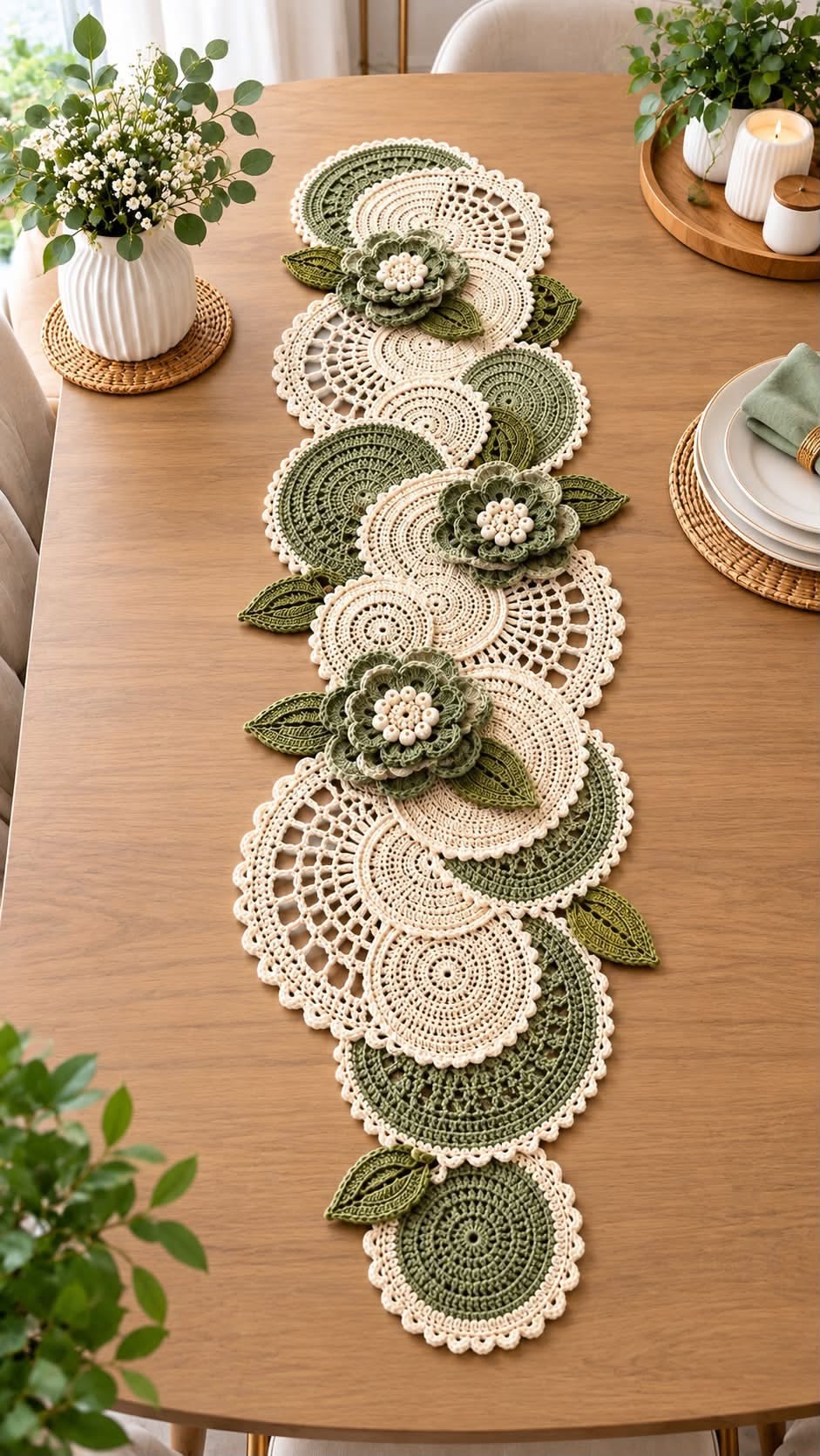
A long decorative table runner made from individual circular crochet motifs, layered floral medallions, openwork doilies, leaves, and three-dimensional flowers.
The main color is cream, with olive and sage green motifs and leaves. The motifs are joined together in a flowing, slightly overlapping arrangement.
1. Cream Circular Motifs
Start with cream yarn.
Round 1: Make a magic ring and crochet 12 single crochets into the ring. Join with a slip stitch.
Round 2: Chain 3, then make 1 double crochet in the same stitch. Work 2 double crochets in every stitch around. Join.
Round 3: Chain 3. Work 1 double crochet in the next stitch, then 2 double crochets in the following stitch. Repeat around.
Round 4: Continue increasing evenly to keep the circle flat.
Round 5: Work groups of double crochet stitches separated by chain spaces to create the decorative openwork.
Round 6: Continue the lace pattern with chain spaces and double crochet groups.
Final Round: Finish with a delicate scalloped edging of single crochet, chain spaces and slip stitches.
Make several cream circles in different sizes.
2. Green Circular Motifs
Using sage or olive green yarn, repeat the circular construction.
Begin with a magic ring and 12 single crochets.
Build the circle with double crochet increases, followed by alternating chain spaces and textured stitch groups.
For the larger green medallions, continue additional rounds before adding the cream scalloped border.
Make approximately:
3 large green circles
2 medium green circles
2–3 small green circles
Varying the sizes gives the runner its natural layered appearance.
3. Large Lace Doilies
Using cream yarn:
Make a central circular motif following the same basic increase structure.
After the center is flat, create several rounds of open lace using:
Double crochet – chain 2 – skip 2 stitches
Repeat around.
For the outer section, work larger chain arches and finish with repeated scallops.
The final border should create a soft, floral-looking edge.
Make 2–3 larger lace medallions.
4. Crochet Leaves
Use olive-green yarn.
Chain approximately 12–15 stitches for the center vein.
Work single crochet along one side of the chain, followed by half double crochet, double crochet and treble crochet toward the widest point.
Work back down the opposite side using the corresponding stitches.
Slip stitch around the entire leaf to create a clean outline.
Add a central vein using slip stitches or surface crochet.
Make approximately 8–12 leaves in different sizes.
5. Layered 3D Flowers
Flower Center
Use cream yarn.
Make a small magic ring and crochet 8–10 single crochets into it.
Add a second round of small petals or loops.
For the flower shown in the design, place several small cream beads or crocheted balls in the center.
First Petal Layer
Using sage green yarn, attach yarn around the center.
Work approximately 8 petals using:
Chain 3
3 double crochets
Chain 3
Slip stitch into the next stitch
Repeat around.
Second Petal Layer
Use a darker green shade.
Work another series of slightly larger petals behind the first layer.
Pull the petals forward and arrange them alternately so the flower becomes three-dimensional.
Make 3 large layered flowers.
6. Flower Assembly
Place the layered flowers over the cream and green circular motifs.
Sew the flower centers securely to the runner.
Position the leaves underneath each flower, with some leaves pointing outward and others following the direction of the runner.
7. Joining the Runner
Arrange the motifs vertically in this approximate order:
Large cream lace motif
Green circular motif
Cream circular motif
Large green motif
Flower with leaves
Cream lace motif
Green motif
Flower with leaves
Cream circular motifs
Large green motif
Flower with leaves
Green circular motif
Allow some motifs to overlap slightly.
Join them with small, neat slip stitches on the back, or sew the motifs together with matching yarn.
Keep the joining points discreet so the runner maintains its delicate appearance.
8. Decorative Border
Once all motifs are connected, use cream yarn around the outside edge.
Work:
Single crochet around the perimeter
Chain 2, skip 1 stitch
3 double crochets in the next space
Chain 2
Slip stitch into the next space
Repeat around the entire outer edge.
Finish with small scallops or picots for the delicate lace effect.
9. Finishing
Weave all yarn ends securely into the back of the work.
Gently wash and block the runner.
Pin the circles, flowers, leaves and scalloped edges into their intended shapes while damp.
Allow it to dry completely before removing the pins.
Final Result
A sophisticated botanical crochet table runner combining cream lace, olive-green circular motifs, delicate leaves and layered 3D flowers. The overlapping motifs create a long organic design that works beautifully as a dining-table centerpiece.