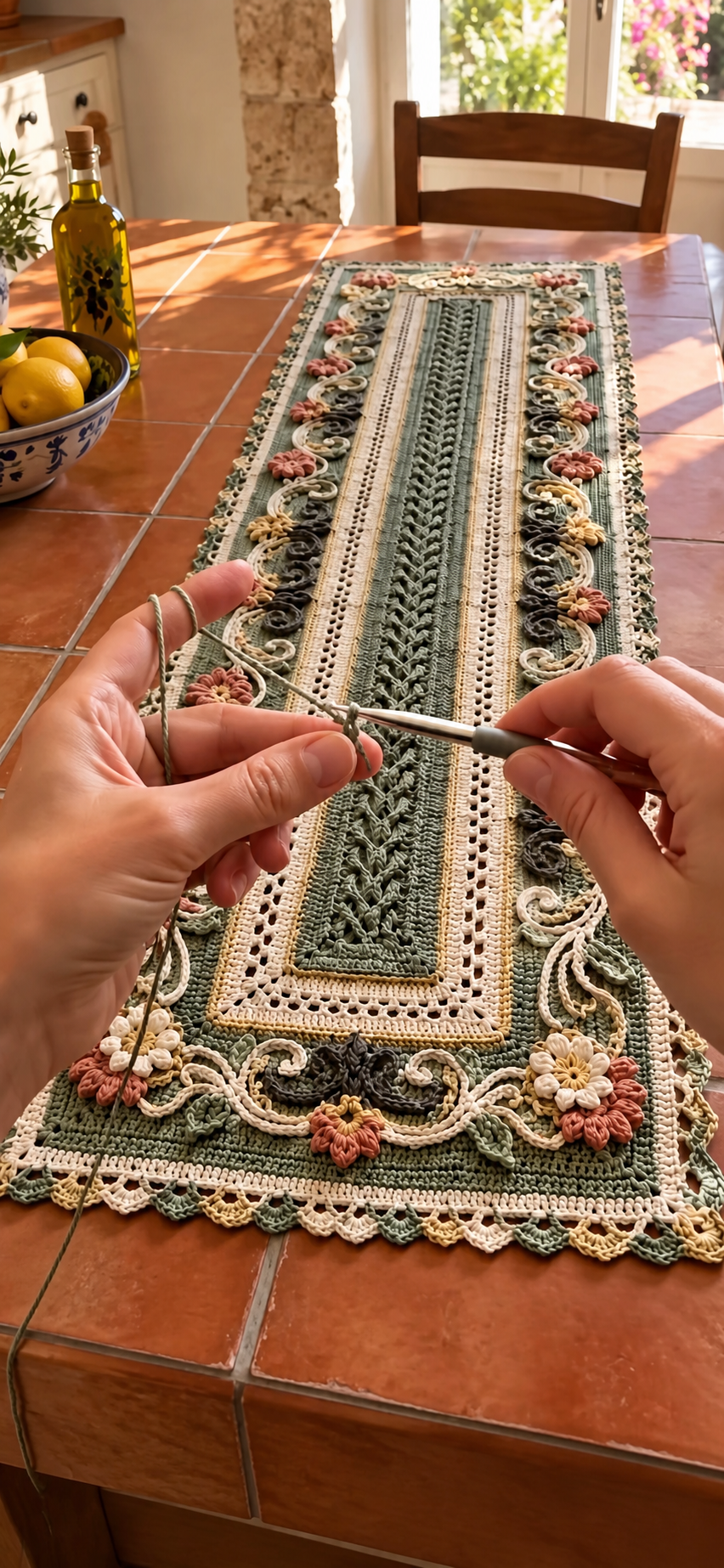

This is an original, untested pattern inspired by the image. The pictured stitches cannot be identified exactly from the photo. This version combines a textured center, ivory openwork, and separately sewn flowers and vines.
Materials
- DK cotton yarn: sage green, ivory, dusty rose, and a little muted yellow
- 3.5–4 mm crochet hook
- Yarn needle, scissors, and stitch markers
Yarn quantity depends on your finished measurements. Make and measure a sample before buying yarn for the entire runner.
US abbreviations
ch = chain; sl st = slip stitch; sc = single crochet; hdc = half double crochet; dc = double crochet; BLO = back loop only; sp = space.
1. Textured center panel
Work this narrow panel across its width, adding rows until it reaches your desired length.
With sage, ch 19.
Row 1: Sc in the second chain from the hook and each chain across. Turn. 18 sc.
Row 2: Ch 1, sc in BLO of every stitch across. Turn. 18 sc.
Repeat Row 2 until the panel measures approximately 100–110 cm, or your preferred length.
Ch 1 and sc evenly around the rectangle, placing 3 sc in each corner. Along the long sides, begin with approximately 1 sc per row end, adjusting only if the edge pulls or ripples. Join with a sl st.
2. Ivory openwork frame
Change to ivory. All rounds face the right side.
Round 1: Ch 1, sc around, working 3 sc in the middle stitch of each corner group. Join.
Round 2: Ch 3, which counts as a dc. Dc around, working (2 dc, ch 2, 2 dc) in each corner stitch. Join to the starting ch 3.
Round 3: Ch 4, which counts as dc and ch 1. Skip the next stitch, dc in the following stitch. Continue ch 1, skip 1 stitch, dc in next stitch along each side. In each corner space, work (dc, ch 2, dc). If a side has one extra stitch, work a dc in it before the corner. Join.
Round 4: Ch 1. Sc in each dc and each ch-1 space. Work 3 sc in each corner space. Join.
Round 5: Repeat Round 2.
Round 6: Repeat Round 3.
Round 7: Repeat Round 4.
Fasten off ivory.
3. Sage floral border
Join sage at a corner.
Round 1: Ch 1, sc around, placing 3 sc in each corner stitch. Join.
Rounds 2–6: Repeat Round 1.
Keep the work flat as you go. This solid band provides a base for the flowers and curling vines. Add more rounds if you want a wider floral border.
4. Raised flowers
Make approximately 16–24 flowers, adjusting the number to your runner’s length.
With muted yellow, make a magic ring.
Round 1: Ch 1, work 6 sc into the ring. Tighten and join. 6 sc.
Change to dusty rose or ivory.
Round 2: In each sc, work (sl st, ch 2, 3 dc, ch 2, sl st). Repeat in all 6 stitches. 6 petals.
Fasten off, leaving a sewing tail. Gently cup the petals with your fingers for a raised shape.
Alternate dusty rose and ivory flowers along the two long sides. Group two or three flowers at each short end.
5. Leaves
With sage, ch 9.
Work along the chain:
- Sl st in the second chain from the hook
- Sc in the next chain
- Hdc in the next chain
- Dc in each of the next 3 chains
- Hdc in the next chain
- Work 3 sc in the last chain
Continue along the unused loops on the opposite side:
- Hdc in the next chain
- Dc in each of the next 3 chains
- Hdc in the next chain
- Sc in the next chain
- Sl st in the last chain
Join and fasten off, leaving a sewing tail. Make 1–2 leaves per flower.
6. Curling vines
With ivory, make a chain long enough to form several loose S-shaped curves along one side of the runner.
Row 1: Sc in the second chain from the hook and each chain across.
Fasten off, leaving a long sewing tail. Make additional lengths as needed.
Pin the cords into curling shapes on the sage border. Sew them down with small stitches, keeping the cords relaxed. For tighter spiral tips, make a separate ch 12, work 2 sc in each chain, and let the strip curl naturally.
7. Decorative center braid
For a raised detail inspired by the photograph:
- Make three sage chains, each slightly longer than the center panel.
- Braid them loosely.
- Lay the braid along the middle of the panel.
- Tack it down at regular intervals without stretching the fabric.
Trim the chains to fit by undoing excess stitches, then secure their ends.
8. Scalloped edging
Join ivory at the outer edge.
Work sc in the next stitch, skip 1 stitch, 5 dc in the next stitch, skip 1 stitch, repeating around.
Near corners, adjust the skipped stitches so the edging lies flat. Join and fasten off.
9. Assembly and finishing
Block the runner base flat before attaching the decorations. Pin the vines first, then position flowers over selected curves and tuck leaves beneath them.
Sew each flower securely through its center and the bases of its petals, leaving the petal tips raised. Weave in every yarn end. Lightly dampen and reshape the finished runner, avoiding pressure on the flowers.
