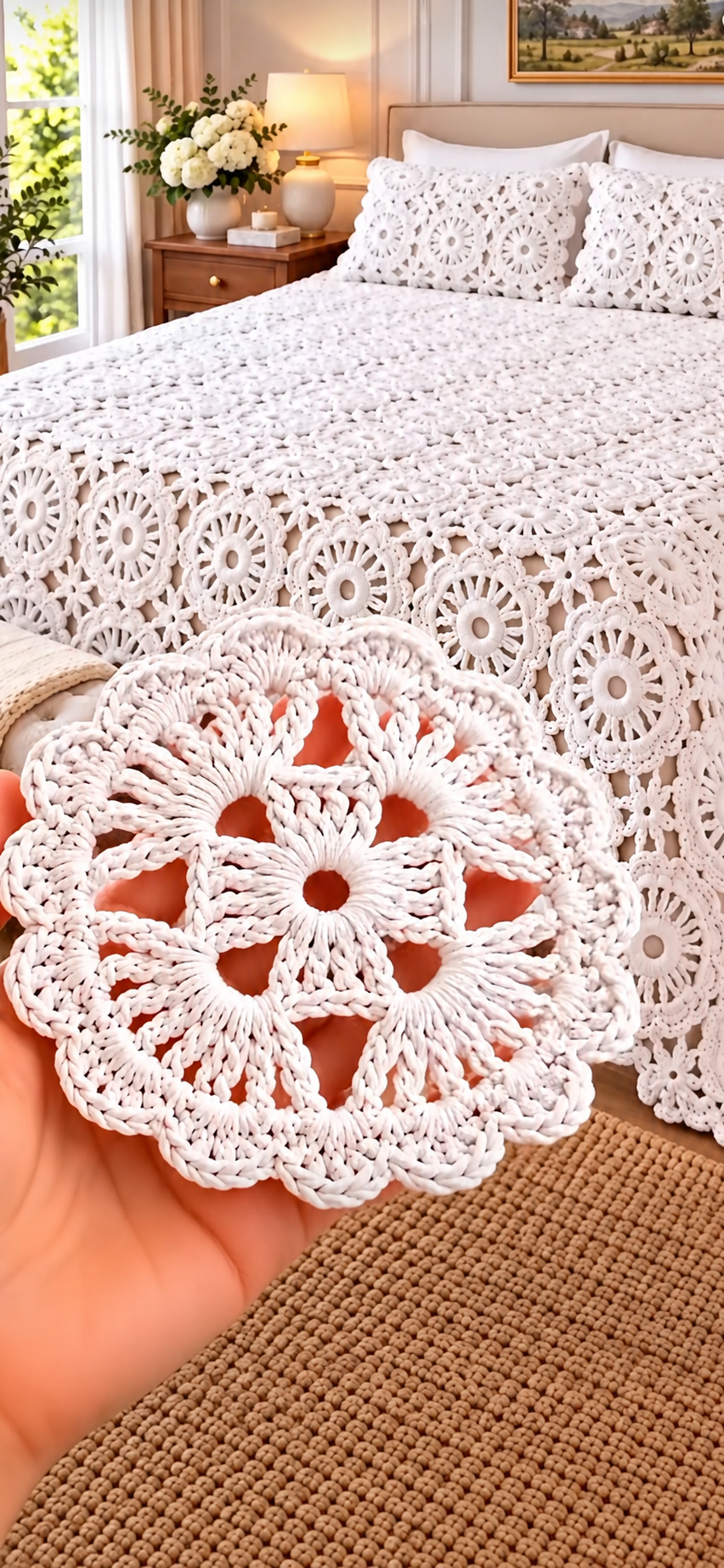

This is an original, untested pattern inspired by the photo, rather than the exact pattern used. Make one sample motif and check that it lies flat before making the full bedspread.
Materials
- White cotton yarn, DK or light worsted weight
- 3.5–4.5 mm crochet hook, suited to your yarn
- Yarn needle and scissors
- Stitch markers
Choose washable yarn and buy the remaining yarn after measuring and weighing your sample.
US crochet terms
- ch: chain
- sl st: slip stitch
- sc: single crochet
- dc: double crochet
- tr: treble crochet
- sp: space
- rep: repeat
Starting ch 3 counts as a dc. Starting ch 4 counts as a tr.
1. Floral motif
The motif has an open center, 12 groups of tall stitches, and a scalloped edge.
Round 1: Ch 10 and join with a sl st to form a ring. Ch 3, work 23 dc into the ring. Join to the top of the starting ch 3.
24 dc.
Round 2: Ch 4, tr in the next stitch, ch 3. Tr in each of the next 2 stitches, ch 3. Repeat from * around. Join to the top of the starting ch 4.
12 groups of 2 tr and 12 ch-3 spaces.
Round 3: Sl st into the next tr, then into the first ch-3 space. Ch 4, work 3 tr in that space, ch 3. Work 4 tr in the next ch-3 space, ch 3. Repeat around. Join to the top of the starting ch 4.
12 groups of 4 tr and 12 ch-3 spaces.
Round 4: Ch 1. Sc in each of the next 4 tr; work (2 sc, ch 3, 2 sc) in the following ch-3 space. Repeat around. Join to the first sc. Fasten off.
Each ch-3 loop is a joining point. Block the motif gently, keeping its circular shape.
2. Join the flowers
Arrange the motifs in staggered rows, like a honeycomb. Each interior flower can touch six neighboring flowers.
Join neighboring motifs at two adjacent loops per shared edge. Use six pairs of loops around each motif, one pair for each potential neighbor.
For a simple sewn join:
- Lay the motifs flat, right sides facing up.
- Align the two loops along the shared edge.
- Whipstitch the corresponding loops together with matching yarn.
- Keep the joins loose enough for the fabric to drape.
Check the arrangement on a flat surface as you work. The small openings between motifs form part of the lace design.
3. Choose the bedspread size
Measure your blocked sample and make a small joined panel before calculating the total number of motifs. Joined flowers overlap slightly, so multiplying a single motif’s diameter will overestimate the finished size.
For the target dimensions:
- Width: mattress width + the desired drop on both sides.
- Length: mattress length + the desired drop at the foot.
Continue adding staggered rows until the panel reaches those measurements.
4. Optional scalloped border
The outer motifs already create a decorative edge. For an additional finish:
Foundation round: Join yarn at an outer loop. Work sc along the exposed edge, placing 3 sc into each outer ch-3 loop. At deep gaps between flowers, use a short chain bridge that spans the gap without pulling. Join.
Scallop round: Skip 2 stitches, work 5 dc in the next stitch, skip 2 stitches, sl st in the next stitch. Repeat around, adjusting the spacing near joins so the border lies flat.
5. Matching pillow fronts
Join enough motifs to cover the front of your pillow. Sew the crochet panel onto a plain white fabric cushion cover, securing the perimeter and a few joining points. The fabric backing supports the open lace.
Finishing: Weave in all ends, wash according to the yarn label, and dry flat. Shape the flowers gently while damp.
